

Ask a man about his accessories and he will show you his wrist. The watch conversation eats all the oxygen in men’s style, and fair enough – a good watch is a beautiful thing. But here is the odd part: the watch is the one accessory you almost never touch. You glance at it. The accessories that actually earn their keep are the ones your hands find without thinking. The pen in your jacket pocket. The ring you turn while you are on a call. The small thing on your desk that you pick up every time you are thinking something through.
This is about those. The quiet ones.
The Pocket Square
The pocket square is the cheapest way to look like you tried. It costs almost nothing, it takes five seconds, and it changes the whole jacket. White linen, one straight fold, is all most men will ever need. In winter, wool. In summer, linen or cotton. The one rule worth following: never match it exactly to your tie. Match it to your shirt, or to nothing at all. A square that matches the tie looks like it came in a box set, and everyone can tell.
It also has a practical side people forget. It is a handkerchief. It has wiped glasses, cleaned a phone screen, and saved more than one sneeze in a meeting. Buy three – white, navy, and something with a pattern you actually like – and you are set for years.
A Bracelet That Doesn’t Try Too Hard
Bracelets are where a lot of men go wrong, usually by wearing three at once. One is enough. Leather, beads, or a plain metal cuff – pick the one that looks like it belongs to you and leave the rest in the drawer.
The test is simple. Put it on in the morning and forget about it by lunch. If you are still aware of it at dinner, it is too tight, too loud, or too new. A good bracelet should age with you. Leather darkens. Beads pick up small marks. That is not damage; that is the whole point. The best accessories are the ones that look better after a year of being worn than they did in the shop.
The Pen You Actually Write With
Here is a strange fact about men’s accessories: the one a man uses most is the one he thinks about least. A good pen gets picked up a dozen times a day, and most of us are still writing with whatever the hotel gave us.
It does not need to be expensive. It needs weight, a refill you can actually buy, and a shape that survives being dropped on concrete. Metal beats plastic – not for the look, for the feel. A pen with some heft writes better because your hand relaxes around it. Keep one in your jacket and one on your desk, and stop borrowing other people’s.
I make small metal objects for a living, and the pen is the one people tell me about most. Not because it is the fanciest thing I make, but because it is the one they carry every single day. That is the real test of an accessory: does it leave the house with you?
Rings With a Reason
A wedding band needs no explanation. Every other ring does. A signet, a band from a trip that mattered, something your grandfather wore – the ring works when there is a story behind it, even if you are the only one who knows it.
The rule is the same as for bracelets: one, maybe two, and never matching sets. If you cannot say why you wear it, you probably should not be wearing it. And keep the metal consistent with the rest of what you wear. Silver-toned pieces together, warm-toned pieces together. Mixed metals can work, but they work on purpose or not at all.
The Pocket Knife, Done Right
A small, well-made folding knife is a tool first and an accessory second, and that order matters. It opens boxes, cuts a loose thread, slices an apple. The point is not to show it off. The point is to have it when you need it and forget about it when you do not.
Keep it simple. A clean blade, a handle that feels good in the hand, nothing that looks like it belongs in a movie. Check the laws where you live, keep it out of sight at dinner, and never make a performance out of using it. The best everyday tools are the boring ones – the ones that work every time and never draw a second glance.
The Desk Object
This is the accessory nobody sees but you, which is exactly why it matters. Everyone has something on their desk they touch while they think. For most people it is a pen cap or a paperclip. It might as well be something made properly.
I am biased here – I spend my days hand-finishing small objects that sit on desks – but the logic holds whoever makes them. A small handmade piece, something with weight and a surface your thumb likes, gives restless hands a place to go. It is not decoration. It is the thing you reach for during the long call, the thing you turn over while you work out a problem. I write about the small handmade objects that earn their place on a desk over on our blog, because once you start noticing them, you start noticing how much of your day your hands spend looking for something to do.
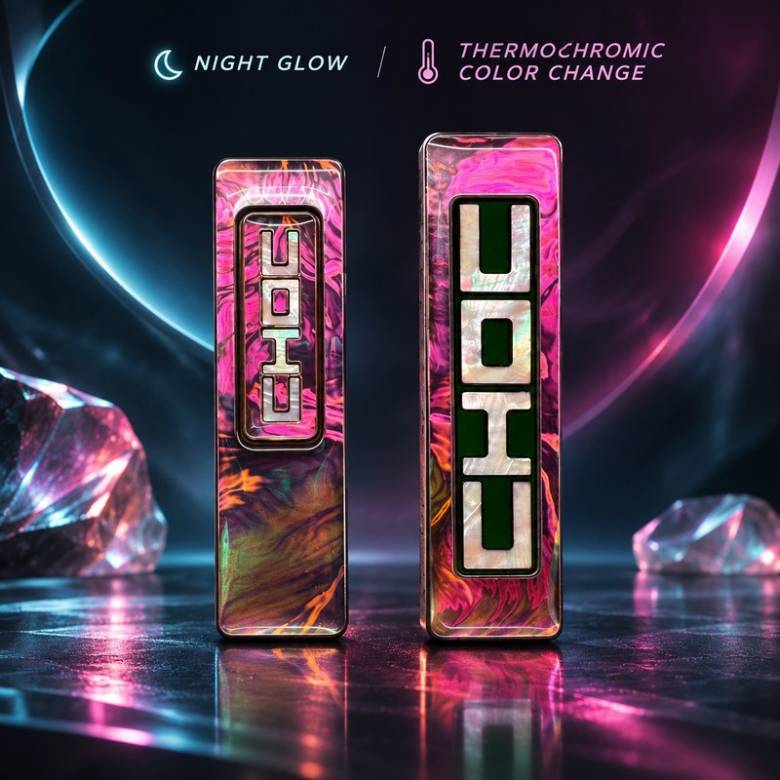
The crystal-sealed LAUTIE Choc, hand-finished in natural mother-of-pearl.
How to Choose
Three rules, and they cover almost everything.
First, buy one good thing instead of three average ones. A single well-made piece you wear every day beats a drawer full of almost-right ones.
Second, let materials age. Leather darkens, brass picks up marks, linen softens. If a material looks worse after a year of use, it was the wrong material. If it looks better, you bought the right thing.
Third, if it needs a logo to look expensive, it is not expensive. The best accessories do not announce themselves. They sit quietly on a wrist, in a pocket, or on a desk, and they get better the longer they stay there.
A watch tells people what time it is. Everything else tells them who you are – slowly, quietly, every day. Pick the pieces that will still be yours in ten years.
—
About the author: Mu is the founder of M-EDC, a one-maker studio hand-finishing small everyday-carry pieces, one at a time.
